Provide students with a detailed rubric, or explicit expectations for assignments
- Lays out how an assignment will be assessed
- This will help students understand the expectations
- When teachers make sure their students “have a clear understanding of expectations for each assignment” they will increase task initiation and completion (Hodgkinson & Parks, 2016, p. 211).
Provide students with directions in verbal, visual, and/or written formats
- Directions should be clear and concise.
- Illustrations of directions allow one more pathway for task memorization, increasing the odds that a student will be able to remember all the directions of a given task.
- Having written directions accompanied by illustrations will provide students an effective reference for any steps they may forget.
Having students repeat directions back to the teacher will help the student commit instructions to memory as well as allow the teacher the ability to know that initial comprehension took place.
Teaching students to use acronyms, or other mnemonic devices can help students remember larger concepts.
- RAPS
- Read/Rephrase
- Ask/Answer
- Plan/Predict
- Solve/Summarize
- “Providing students with acronyms or verbal strategies such as RAPS helps them know where to start and to remember the important steps for problem-solving that can make a major difference in their performance and result in success” (Steinberg & Roditi, 2018, p. 305).

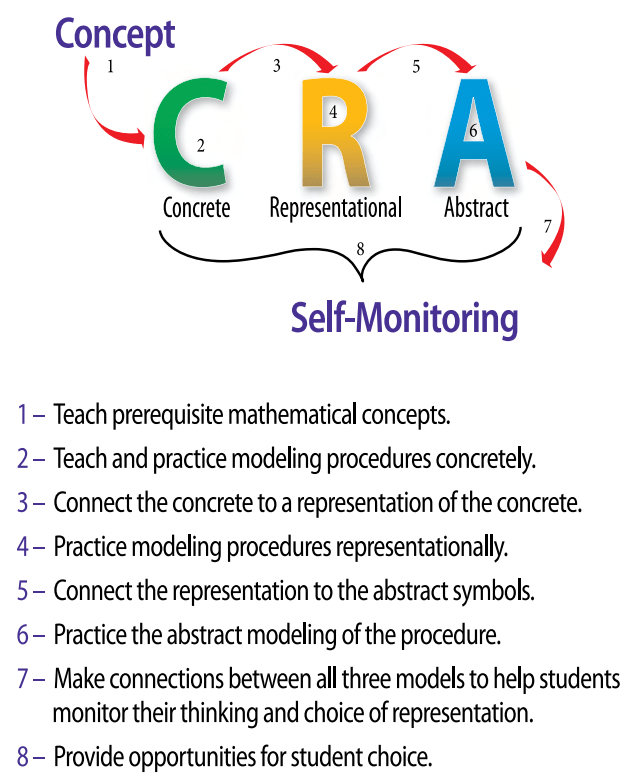
Concrete-representational-abstract sequence (CRA) and strategic instruction model (SIM), which “focus on development of conceptual and procedural knowledge in mathematics operations”, are effective strategies for teaching math computation (Flores, Hinton & Strozier, 2014).
Provide students with post-it notes to take quick notes.
Have students voice-record their directions to play back to themselves when needed.
 Executive Function