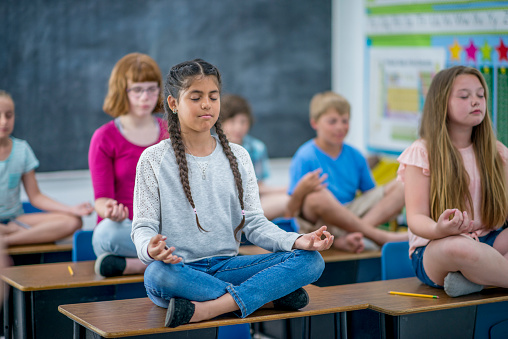
Self-calming strategies can be used to support students who struggle with emotional regulation. Teachers can model and guide students through breathing and visualization exercises (Hodgkinson & Parks, 2016, p. 212).
- Breathing Exercises
- Deep Belly Breaths – Have the student put their hands on their belly. Ask them to take a big breath in and slowly blow it out. While they are taking big breaths ask them if they can feel their stomach rising and falling.
- Five Finger Breathing/Roller Coaster Breaths – https://www.youtube.com/watch?v=HQVZgpyVQ78
- Flower and Candle – Have students breathe in through their nose like they are smelling a flower and breathe out through their mouth like they are blowing out a candle.
- Visualization Exercises
- Chill To Change Guided Imagery: https://www.changetochill.org/guided-imagery/
Resource: Classroom Relaxation Exercises
Verbal and non-verbal prompts can be used to support students who struggle with impulse control in the classroom.
- Verbal Prompts (separate the action from the person)
- “It is difficult for your classmates to concentrate when you are talking”
- “Your ‘feeling brain’ has taken over your ‘thinking brain’” (Hodgkinson & Parks, 2016, p. 212)
- Non-Verbal Prompts
- Put finger up to lips to signal it is time to be quiet
- Rest hand at the end of the student’s desk
- Give students “the look” (Hodgkinson & Parks, 2016, p. 212)
 Executive Function